


Requested Tips and Tools From Our Club Members
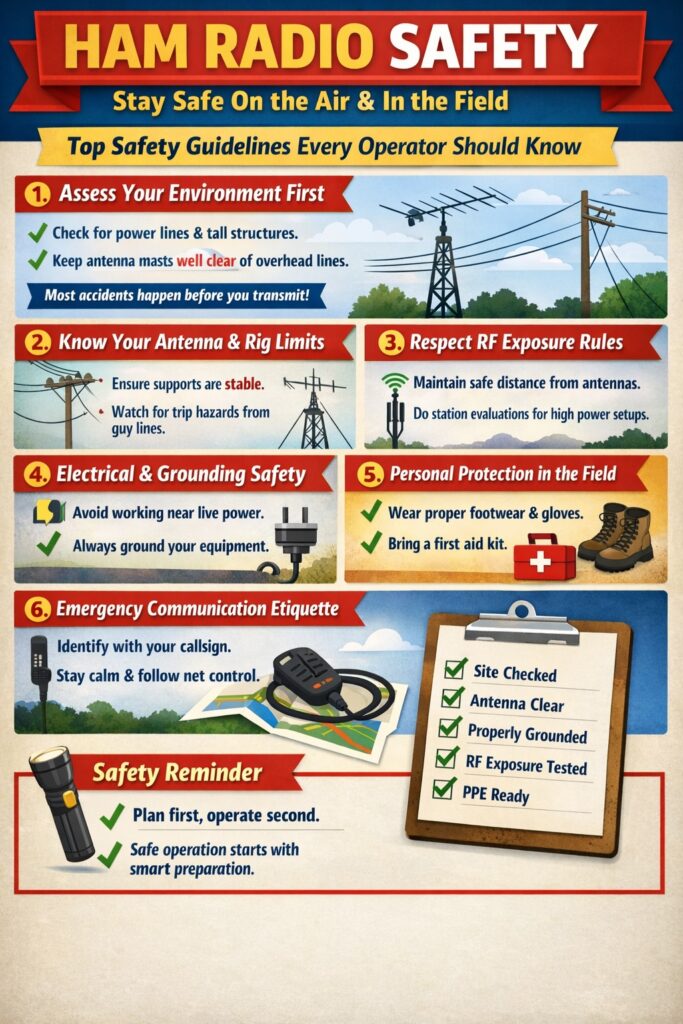
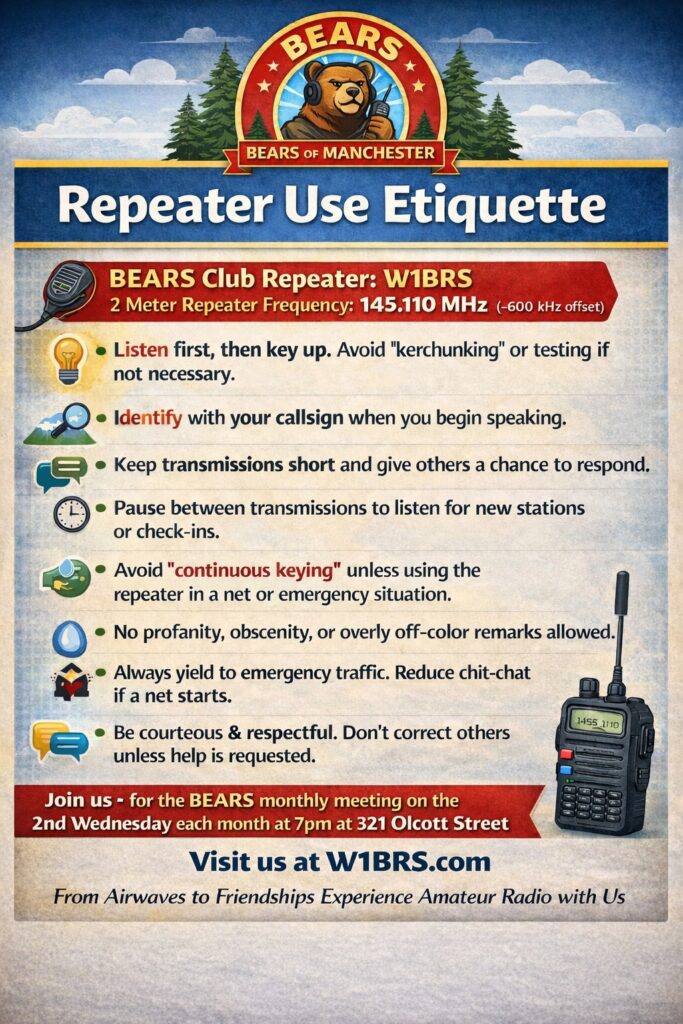
- If you need to test your signal into a repeater do so by saying your call sign followed by “testing.” If you hear the repeater’s courtesy tone after you speak, you’re successfully reaching it. When keying the mic to test your signal to the repeater always always say your callsign and never just key the mic without identifying yourself. That is considered very poor practice and reflects poorly on yourself.
- Always listen first before transmitting. If the repeater is busy, wait for a break before calling. Ask if the repeater is in use before speaking and avoid interrupting ongoing conversations.
- Repeater etiquette is important. Welcome new operators, be friendly, and keep conversations concise to allow others to use the repeater.
- Remember, repeaters aren’t private. Your conversations can be heard by many, so use polite language and be mindful of who might be listening. Always refrain from speaking unkindly about others, as it only reflrects negatively on yourself.
- Mistakes happen. If you accidentally interrupt a conversation, apologize and move on.
- For more tips, check out suggestions from Dana Underhill KB1AEV, owner of the KB1AEV & Linked Repeater System.
Current Band Conditions
- Data for VHF Conditions is from
DXrobot – Gouda, Make More Miles on VHF,
and Andy (G7IZU) (all used with permission). - Data for Solar Flare Probability is from
University of Bradford (used with permission). - Data for solar data and conditions from
NOAA SWPC, solar flux from Space WX Canada, MUF data from Lowell GIRO Data Center (LGDC), solar images from NASA, and world map/globes/solar system from Fourmilab (credit given)
Propagation
- RF Line Of Sight
- Propagation Predictions
- Live RF Propagation Maps
Setup your Winlink STATION
by BEARS Member Chuck Rexroad ab1cr
Chuck gave an awesome Winlink presentation to the BEARS of Manchester at their March 2025 monthly meeting.
If you’re a BEARS member and have any questions after watching the presentation send Chuck an email crexroad34@gmail.com even if it is just to say thank you and let him know if you tried and were successful getting your Winlink station working. He might even offer to be your personal guide should you run into any roadblocks getting your Winlink station to work.
Chuck offers two additional downloadable formats. A traditional video format but will require you to have a compatible video player software and the Winlink Presentation Slides which allows you to switch from one slide to the next and has a video of Chuck in the lower corner as he narrates the information on the slides.
Operating a special event station
by BEARS Member Jim payant WE1SAX
Are you a licensed ham that has operating privileges on 2 meter and 6 meter simplex or the HF bands? If yes then please read on as this opportunity might interest you because the operators of this special event are encouraged to invite contacts on 2 meter and 6 meter single side band simplex.
Each year starting July 1 (9AM Eastern) to July 7 (Midnight Eastern) an amateur radio commemorative special event celebrating the 13 Colonies occurs. Amateur radio enthusiasts participate in the “13 Colonies Special Event” to commemorate the history of the original thirteen American colonies. This annual event celebrates Independence Day (July 4th) and encourages operators to contact special event stations representing each colony, aiming for a certificate or award. It combines radio communication with historical appreciation, fostering camaraderie among operators worldwide.
Visit the 13 Colonies Special Event Website Here
Watch the video which describes what it was like to participate in or operate a special event station.
The Practical Side of Fox Hunting
by BEARS Member Dan Thayer W1CDT
While foxhunting is a fun activity, the hunting skills developed also have a very practical application.
The 146.94 Mt Tom (MA) repeater had been suffering with constant “kerchunking” for two weeks, but only during the daylight hours. The incessant interference rendered the repeater useless during the day. This was attributed to malicious interference. It was later determined that the source of the signal was likely a simplex repeater, as it was storing what was transmitted on the repeater, and then immediately replaying it back through the repeater.
Dana, KB1AEV, was finally able to find an area in Massachusetts where the signal was full scale. Over the course of the day four hams (N1ZXL, W1CDT, N1RUU, and NC7R) each devoted time to independently hunting the emitter, which was finally located at another ham’s home, and independently verified.
The ham was contacted, and immediately turned off the simplex repeater. It was learned that the ham had been on vacation for two weeks. Just prior to departing for vacation, he had set up a licensed GMRS simplex repeater, powered by a small gel-cell battery and solar power.
At some point the battery failed, and the HT it was powering lost power. When the solar cells restored power, the HT came up on a different memory frequency, which happened to be the 94 repeater. Since it was transmitting constantly during the day, the solar cells could not make much headway towards recharging the battery, but did achieve a level that prevented the HT from shutting down, although its low voltage sensor kept it from transmitting until the sun came up. This was a classic transmitter hunt, involving teamwork to develop an increasingly small geographic area of operation, the sharing of hunting information and results with other hunters, the taking of bearing on the target signal, plotting of these directional cuts to obtain an approximate fix, and the final location of the transmitter. Lesson learned?
Never leave equipment turned on when you go on vacation.
BEARS MEMBER Bill kc1jts tames the octopus / spider antenna
Bill presented this topic at the BEARS monthly meeting in May 2024. Bill has a two part video he shares with us here. Part 1 is a brief intro while his followers asked for a few more details in Part 2
Part 1
Part 2
BEARS MEMBER Rob N1NUG mentions the BEARS repeater
Rob discusses how the bandwidth settings you program into your transceiver can affect how others may or may not hear you on the repeater.